TUNES, SONGS, DANCES, ETC. • SITES • RECORDINGS • OTHER FUN THINGS
TUNES, SONGS, DANCES, ETC.
August, 1812
"God Save the King" at the fall of Detroit
Lydia Bacon, witnessing the fall of Detroit, listens as "enemy musicians played 'God Save the King' in ‘the most lively manner'" (via IN THE MIDST OF ALARMS: THE UNTOLD STORY OF WOMEN AND THE WAR OF 1812, p. 338).November, 1812
"New Recruiting Song" (to tune of "Yankee Doodle")
From the Pennsylvania newspaper The Reporter (via ALARMS, p. 3):To meet Britannia’s hostile bands
We’ll march, our heroes say, sir,
We’ll join all hearts, we’ll join all hands;
Brave boys we’ll win the day, sir.
(complete lyrics here)December, 1812
"Hail, Columbia" at a Washington Ball
At a Washington ball to celebrate the victory of the USS Constitution over HMS Guerriére, Commodore Stephen Decatur crashes the party with news of his victory as captain of the USS United States over HMS Macedonian. After Decatur's lieutenant presents the Macedonian's flag to Dolley Madison, the crowd spontaneously bursts into song with "Hail, Columbia" ( ALARMS, p. 230).January, 1813
"Sweet Poll of Plymouth" at concert honoring Decatur
Actress Eleanora Darly sings this at a special concert in New London honoring Stephen Decatur and the crew of the USS United States after their victory over HMS Macedonian (ALARMS, p. 448, note 1).Sweet Poll of Plymouth was my dear,
When forc'd from her to go,
Adown her cheek rained many a tear,
My heart was fraught with woe.
Our anchor weigh'd for sea we stood,
The land we left behind,
Her tears then swell'd the briny flood,
My sighs increas'd the wind.
(complete lyrics here)June, 1814
"Rule Britannia" at Buckingham House after war ends between Britain and France
Ater the announcement of peace between Britain and France, lots of doings at Buckingham House. “On the front lawn,” writes Walter Lord in THE DAWN'S EARLY LIGHT, “the band of the Royal Horse Guards was stationed, with its great silver kettle drums thundering in time to ‘Rule Britannia.’” (p. 40)June, 1814
A Country Dance and Drama aboard British ships bound for America
British on their way to take on the Americans (after defeat of Napolean) entertain themselves with music and theatre. "The men on the Weser, writes Lord, "attempted a production of Sheridan’s The Rivals.... On calmer evenings the superb band of the Menelaus serenaded the nearby ships, reminding everyone of home." Later, on the Royal Oak, there’s a play -- The Apprentice -- and a grand ball which opens with "a country dance" (THE DAWN'S EARLY LIGHT, p. 41)August, 1814
British play Handel tunes as they (i.e. the British, not the tunes) march toward Washington
As British soldiers marched toward Washington, "Full-throated buglers and synchronized drummers filled the air with stirring notes from Handel's much-loved opera Judas Maccabeus. The long lines of aroused soldiers needed no further prompting. A chorus of masculine voices took up the defiant words in lusty unison as they sang like a triumphant army: 'See the conquering hero comes / Sound the trumpet, beat the drums'" (THE BURNING OF WASHINGTON, p. 34).August 24, 1814
Burnt musical offerings at the President's House
During burning of White House, "...the pianoforte from Andrew Hazlehurst...the $28 guitar--all of it went up in one roaring bonfire" (THE DAWN'S EARLY LIGHT, p. 169).August 25, 1814
System of Drum-Beating Helps Burn Washington
British army Major Timothy Jones led a column up Pennsylvania Avenue to "the rather pedestrian brick building that housed the State, War and Navy Departments.... The Americans had moved most of the current records, but there was still plenty of fuel. Fed by such varied kindling as Secretary [of the Navy] Jones’s furniture and undistributed copies of the army’s System of Drum-Beating, the fire quickly mushroomed through the building" (THE DAWN'S EARLY LIGHT, p. 174)September 13, 1814
"Yankee Doodle" at Fort McHenry
"Yankee Doodle" gets played a lot. For instance, during the British attack on Fort McHenry, some soldiers in the fort successfully hit nearby British frigates. "As their ammunition struck the stationary ships in several places," writes Anthony Pitch in THE BURNING OF WASHINGTON, "jubilant artillerymen cheered and hollered, their spirits lifted even higher when musicians piped out the jaunty tune of 'Yankee Doodle'" (p. 206).January, 1815
"Marseilles," "Yankee Doodle" and other music as New Orleans prepares for battle
As the folks of New Orleans prepared for battle, "The streets resounded with Yankee Doodle, the Marseilles Hymn, the Chant du Depart, and other martial airs..." (LIFE OF ANDREW JACKSON, p. 67).January, 1815
Drumming, "La Marseillaise," and "En Avan’ Grenadié" during the Battle of New Orleans
From THE MUSIC OF BLACK AMERICANS: A HISTORY, page 66:A New Orleans newspaper carried an item referring to Jordan B. Noble (ca. 1796-1890) of the Seventh Regiment of Infantry as a “matchless drummer”; he “beat his drum during all and every fight, in the hottest hell of the fire, and was complimented by [General Andrew] Jackson himself after the battle....” It was said that the “colored Creoles” of Louisiana who fought in the Battle of New Orleans had their own special war song, En Avan’ Grenadié (“Go forward, grenadiers; he who is dead required no ration”), which they sang along with La Marseillaise and other songs. And that is the sum of the knowledge we have.
February, 1815
The Jacksons dance to "Possum up de Gum Tree"
At a dinner and ball for George Washington's birthday, Andrew Jackson and his wife dance "a most delicious pas de deux" country-style. "A long, haggard man, with limbs like a skeleton, and Madame La Generale, a short, fat dumpling, bobbing opposite each other like half-drunken Indians, to the wild melody of 'Possum up de Gum Tree' and endeavoring to make a spring into the air..." (from REAL LIFE AT THE WHITE HOUSE, by John Whitcomb and Claire Whitcomb, p. 62).February 14, 1815
Paul Jennings fiddles "President's March" for Madison
When news of peace arrived, Paul Jennings, one of President Madison's slaves, "played the President's March on the violin...." See A Colored Man's Reminiscences of James Madison.February 16, 1815
Cotillions at Boston Peace Ball
During the Peace Ball at Boston Concert Hall, Eliza Susan Quincy dances "several cotillions." (ALARMS, p. 380).February 25, 1815
British play "Yankee Doodle" for Americans
Just after they've learned of the peace treaty between the United States and Britain, "a party of American officers crossed [Lake Ontario] from Sackets Harbor and were welcomed to dinner by their British opposite numbers, who insisted on a regimental band playing 'Yankee Doodle' and drinking President Madison's health." (from p. 382 of ALARMS)Undated
"When Wild War's Deadly Blast Was Blawn"
The song that Donald Graves calls "The Sodger's Return" (see the link to Graves' Songs of the War of 1812 list below) is actually a fragment of the wonderful Robert Burns poem, "When Wild War's Deadly Blast Was Blawn": lyrics / iTunes -- see track 3.British Bugles & Drums (from THE DAWN'S EARLY LIGHT)
Various Dates
- "flankers equipped with bugles" (p. 54)
- March to Bladensburg: “The bugles played a lively tune...." (p. 119)
- "...the bugles and drums began sounding." (p. 121)
- "With his bugler now sounding the attack...." (p. 126)
- August 24, 1814 -- The two commanders -- Ross and Cockburn -- decide to “lay the city under contribution as the price of sparing it. Now a drum rolled loud and long, sounding the call for a parley.” But no one answers. (p. 160)
- September 12, 1814 -- "At 7 A.M. the bugles sounded, and the British force -- now 4,700 strong-- started for Baltimore."
- "About 3:00 Brooke gave the signal...the orderly bugler sounded the charge...the other bugles took it up all along the line." (p. 266)
- "Late afternoon the bugles sounded halt." (p. 269)
American Drums (also from THE DAWN'S EARLY LIGHT)
Various Dates
- "At 2 A.M. on the 22nd the drums beat reveille in the American camp at the Wood Yard." (p. 69)
- During preparations for defense of Baltimore: "Early every morning the groups working that day got their assignments and began to dig. At 10:00 A.M. the drum beat for grog. At noon it beat for dinner and more grog. At 3:00 P.M., and again at 5:00, there were breaks for still more grog. At 6:00 the drum finally beat retreat" (p. 219).
- September 11, 1814 -- Baltimoreans and three out-of-town volunteer companies head toward North Point, "at 3:00 P.M. the men fell in and headed east on Baltimore Street. Led by fife and drum, they presented the usual mixture of dashing uniforms and civilian dress" (p. 253).
- Sept. 13, 1814 -- "Even though Fort McHenry had now become the principal target, troops on Hampstead Hill were under strict orders to remain at the ready. When officers strolled off to get their evening meals they were forbidden to stray beyond the sound of a warning drum, and if the drummer signaled a special roll they would have to get back at the double" (p. 209)
SITES
back to top
- Songs of the War of 1812 (via Donald Graves)
- Index to Henry Livingston's Music Manuscript, circa 1815
- Fife and Drum (via Sturbridge Colonial Militia) -- lots of great tunes, e.g. "Yankee Doodle."
- Lyrics to "The Constitution and the Guerriére"
- Lyrics to "The Shannon and the Chesapeake"
- Old Ironsides -- USS Constitution museum
RECORDINGS
back to top
- Ballads of the War of 1812 (1791-1836) -- Wallace House
- The Battle of Plattsburgh : Songs and Tunes of 1814 -- Stan Ransom
- Colonial and Revolution Songs -- Keith and Rusty McNeil. Contains a section devoted to War of 1812 songs which includes the following:
- "The Eighth of January"
- "The Constitution and the Guerriere"
- "Sinclair's Defeat"
- "To Anacreon In Heaven"
- "Parliament Of England"
- "Patriotic Diggers"
- "The Noble Lads Of Canada"
- "The Hunters of Kentucky"
OTHER FUN THINGS
back to top
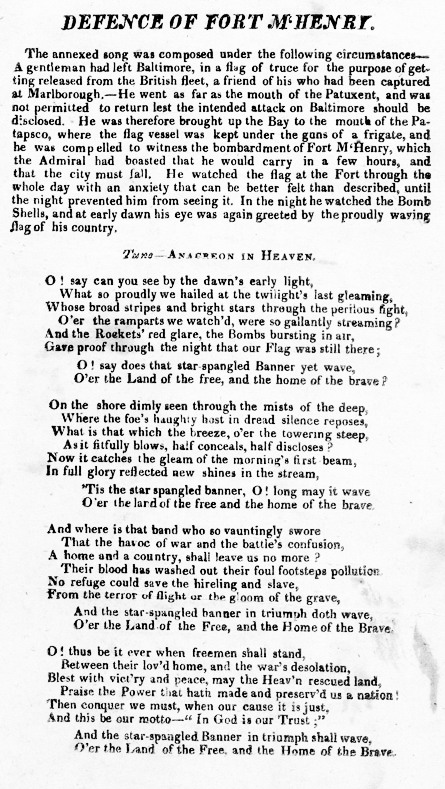
- "Defence of Fort McHenry" broadside
- "Adams & Liberty" (full text)
- "When the Warrior Returns"
A song Francis Scott Key wrote in 1805 to the tune of "Anacreon in Heaven," honoring naval heroes of the war with the Barbary pirates. I include this here to emphasize that Key had the tune of the "Banner" in mind when he wrote it.- "To Anacreon in Heaven"
Original song on which Francis Scott Key based "When the Warrior Returns" and "The Star-Spangled Banner."- POEMS OF THE LATE FRANCIS SCOTT KEY
Key wrote more verse than just the "Defence of Fort McHenry." My favorite (at least of the ones I've sampled so far), "To My Cousin Mary, for Mending My Tobacco Pouch," begins:
MY conscience has given me several twitches
For not having thanked my fair coz. for her stitches....